

Pet dental care in Flemington, NJ
From routine cleanings to advanced oral surgery, because dental health shapes your pet's whole-body health.
Dental health is whole-body health
Periodontal disease is the most common clinical condition in companion animals. The AVMA reports that most dogs and cats show evidence of it by age 3. Left untreated, bacteria from infected gums have been associated with kidney, heart, and liver disease, which is why the AVDC and AAHA classify professional cleaning as core preventive medicine, not a cosmetic service.
Our Flemington dental suite features digital dental radiographs, ultrasonic scaling, and high-speed polishing. Every cleaning is a full COHAT (Comprehensive Oral Health Assessment and Treatment) performed under general anesthesia, so we can probe each tooth, capture full-mouth X-rays, and treat disease below the gumline, where most of it hides.
Clover Hill provides complete veterinary dental care in Flemington: COHAT cleanings, full-mouth digital X-rays, extractions, and oral surgery. Every cleaning is performed under general anesthesia following AAHA & AVDC guidelines, with dedicated vitals monitoring and multimodal pain control.
- Performed under general anesthesia, the AAHA & AVDC standard of care
- Full-mouth digital radiographs included with every COHAT
- A dedicated technician monitors vitals the entire procedure
- Multimodal pain protocol: nerve blocks, NSAIDs, and take-home meds
- Same-day discharge for most patients
The state of pet dental health
Most dogs and cats already show signs of periodontal disease.
American Veterinary Medical AssociationOf each tooth sits beneath the gumline. The only way to fully assess it is X-rays under anesthesia.
Cornell Riney Canine Health Center & AVDCHigher risk of chronic kidney disease in dogs with advanced periodontal disease (6.3× for endocarditis).
Banfield State of Pet HealthHigher periodontal-disease risk in small breeds under ~15 lbs versus giant breeds.
Wallis & Holcombe 2020, JSAPOf US dogs receive professional dental care each year, despite AAHA recommending it annually.
American Animal Hospital AssociationOf adult cats are affected by painful tooth resorption, usually invisible without X-rays.
AVDC · feline tooth resorptionWhat sets our dental care apart
Full-mouth digital X-rays
See what's hidden below the gumline, where roughly 60% of dental disease lives.
Anesthesia monitoring
A dedicated technician monitors vitals throughout the entire procedure.
Pain management
Local nerve blocks and multimodal pain control for a comfortable recovery.
Whole-body health
Treating dental disease can improve heart, kidney, and liver function.
Signs your pet needs a dental visit
Pets are experts at hiding oral pain. If you notice any of these, especially two or more, schedule a dental evaluation.
The #1 early sign, caused by bacteria colonizing the gumline.
Active gingivitis, reversible if treated early.
Calculus can't be brushed off. It requires ultrasonic scaling.
Often signals a painful tooth or an oral mass.
A classic sign of a fractured or abscessed tooth.
Often a tooth-root abscess. Needs same-week evaluation.
Requires dental X-rays and likely extraction.
Pets mask pain. Subtle behavior shifts are often the only clue.
What to expect on dental day
Pre-anesthetic bloodwork
Safety screening to confirm your pet is a good anesthesia candidate.
Anesthesia & oral exam
A full exam of every tooth, including probing and digital X-rays.
Cleaning & treatment
Ultrasonic scaling, polishing, any needed extractions, and fluoride.
Recovery & home care
Supervised recovery with pain medication and detailed aftercare.
Dental care by species & breed
Dogs 42 adult teeth
Dogs are most prone to fractured carnassials (the upper 4th premolar), tartar on the cheek teeth, and slab fractures from bones or antlers. Small breeds develop periodontal disease roughly 5× more often than large breeds due to tooth crowding in a smaller jaw.
Cats 30 adult teeth
Cats are uniquely prone to feline tooth resorption, a painful condition affecting 30–70% of adults where the tooth is reabsorbed into the jaw. Resorptive lesions are usually invisible without dental X-rays and almost always require extraction.
Tooth crowding plus a smaller jawbone means up to 5× higher periodontal risk. Plan on cleanings every 6–9 months starting at age 2–3.
Crowded, rotated, sometimes missing teeth trap plaque, and narrower airways need brachycephalic-specific anesthesia protocols, which our team uses as standard.
Lower periodontal risk but higher fracture risk from aggressive chewing. Annual X-rays catch hidden slab fractures on the upper premolars.
Age-related tartar plus a reduced immune response accelerates disease. We always run pre-anesthetic bloodwork and coordinate with any kidney, cardiac, or endocrine conditions.
Keeping teeth clean between visits
Professional cleanings remove existing tartar. At-home care is what keeps it from coming back, and daily prevention can add years between cleanings.
Daily tooth brushing
The gold standard. Use a pet-safe enzymatic toothpaste (never human toothpaste: xylitol and fluoride are toxic) and a soft finger brush. Focus on the outer surfaces of the canines and upper molars.
VOHC-approved chews
Look for the Veterinary Oral Health Council Seal of Acceptance. Greenies, OraVet, Virbac C.E.T., and Purina DentaLife are all VOHC-tested to reduce plaque and tartar.
Prescription dental diets
Hill's t/d and Royal Canin Dental are clinically proven kibbles with a fiber matrix that scrubs the tooth surface as your pet chews.
Water additives
VOHC-accepted additives add a tasteless enzyme to drinking water that inhibits plaque bacteria. Great for pets that resist brushing.
Dental wipes
A middle-ground option for pets that tolerate finger contact but not a brush. Use after meals, focusing on the gumline.
Avoid these
Skip bones, antlers, hooves, hard nylon chews, and ice cubes: the leading cause of fractured teeth in dogs. Tennis balls abrade enamel over time, too.
The veterinarians at Clover Hill
Every procedure at Clover Hill is performed by a named veterinarian you can get to know before your visit.
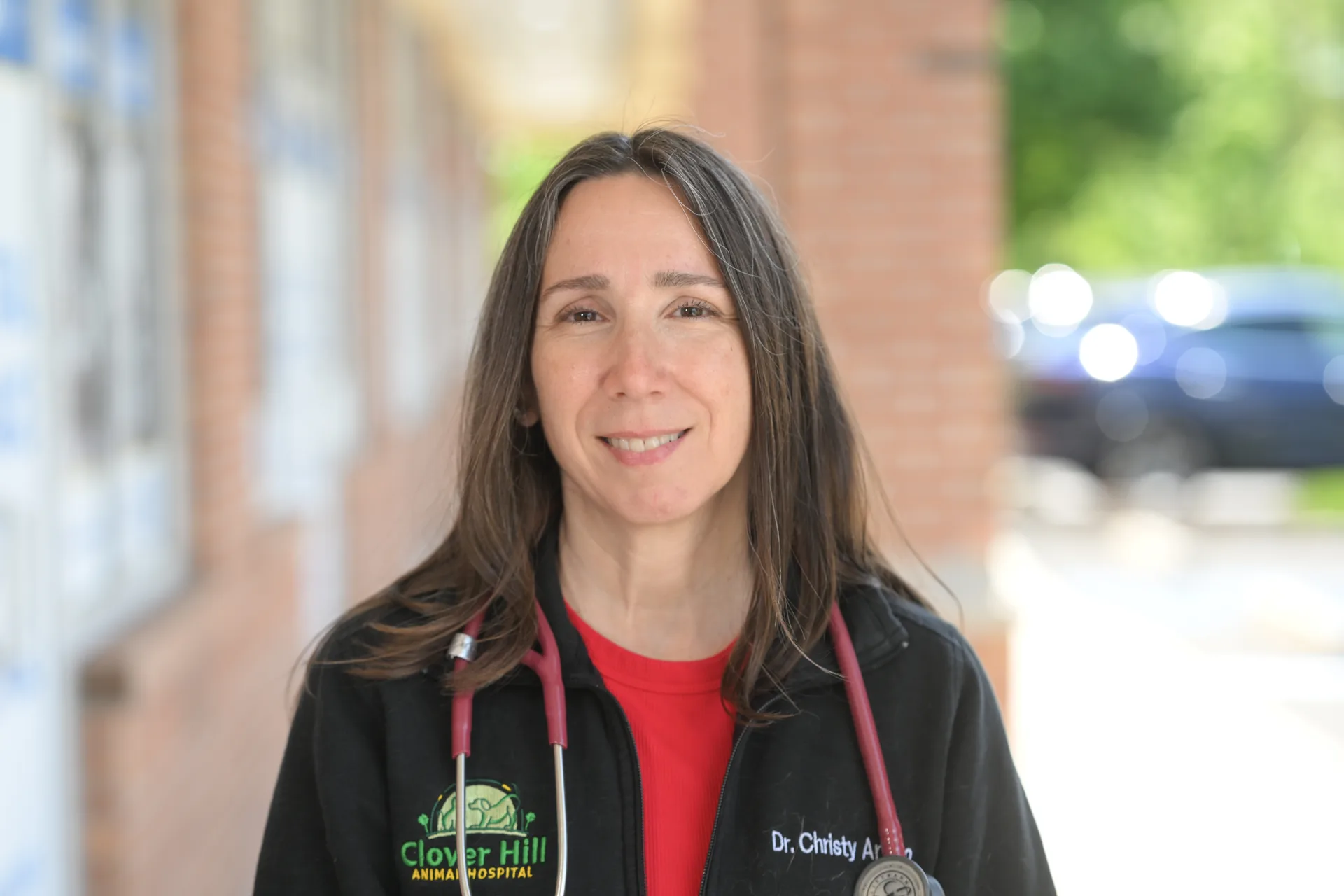
Dr. Christy Artuso
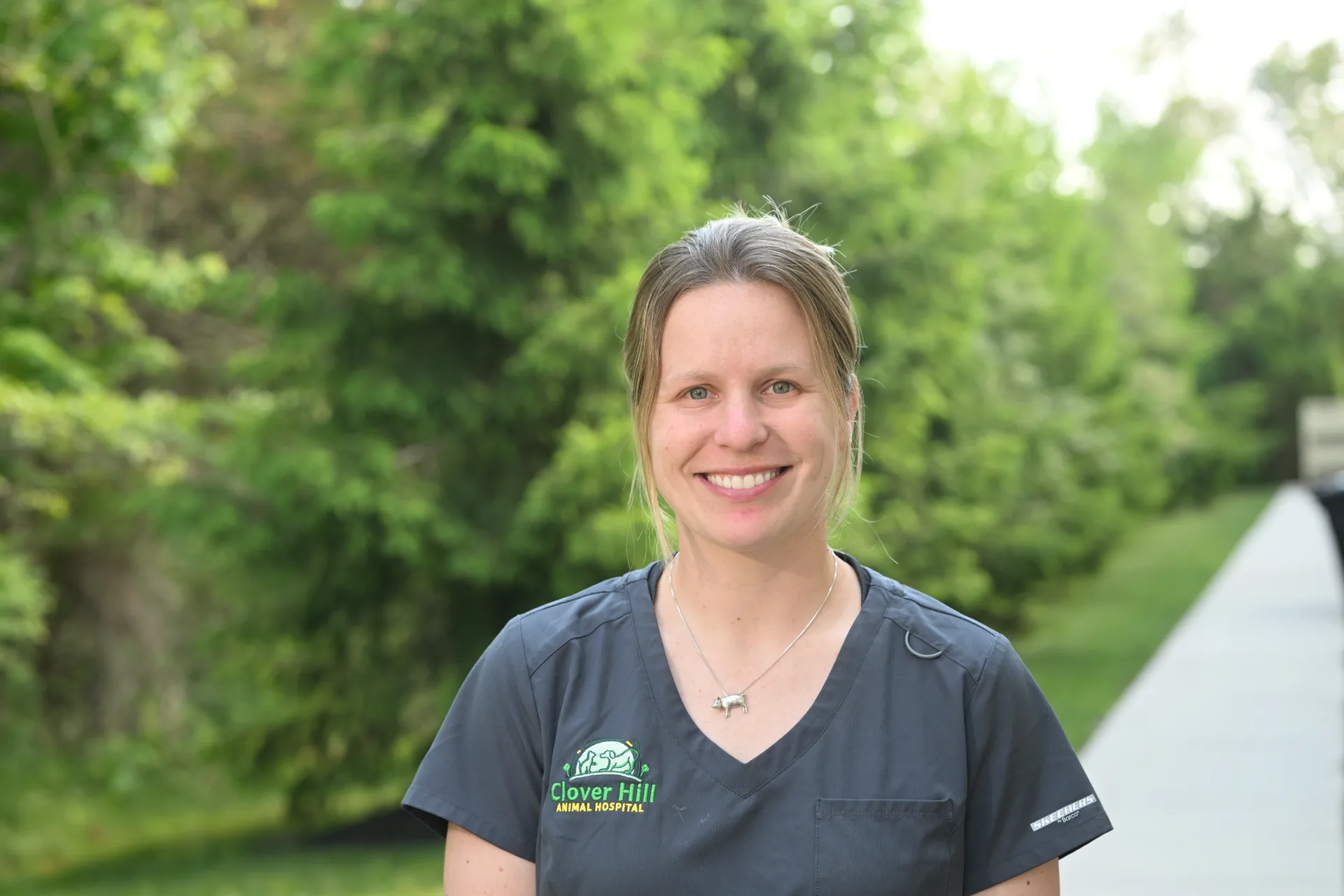
Dr. Chelsey Smentkowski

Dr. Ann Ascher

Dr. Jamie Abato
Dental care questions
Why does a dental cleaning require anesthesia?
Anesthesia lets us perform a complete, pain-free cleaning, including subgingival scaling, full-mouth digital X-rays, and precise probing of each tooth. It protects the airway from aspiration, keeps your pet still for delicate instruments, and lets us treat painful findings in the same visit. The AVDC has formally opposed anesthesia-free dentistry since 2004.
How safe is anesthesia for my dog or cat?
Modern veterinary anesthesia is very safe. Studies cite anesthetic mortality at roughly 0.05% in healthy dogs and 0.11% in healthy cats. Every dental patient receives pre-anesthetic bloodwork, an IV catheter with fluids, body-temperature support, and continuous monitoring of ECG, blood pressure, SpO2, CO2, and temperature by a dedicated technician.
How often should my pet have a dental cleaning?
Most adult dogs and cats benefit from an annual professional cleaning. Small breeds, brachycephalic (flat-faced) breeds, and seniors often need cleanings every 6–9 months because their mouths accumulate plaque faster and are more prone to tooth crowding.
What is a COHAT?
COHAT stands for Comprehensive Oral Health Assessment and Treatment, the AVDC-recommended term for a modern dental procedure that includes full-mouth digital X-rays, a tooth-by-tooth probing exam, ultrasonic scaling, polishing, and treatment of any disease found, all in one anesthetized visit.
How long does the procedure and recovery take?
Plan on a full-day stay: drop-off 7:00–8:00 AM, a 60–120 minute procedure (longer with extractions), and pickup by late afternoon. Most pets are back to normal within 24–48 hours after a routine cleaning; with extractions, we recommend soft food and reduced activity for 10–14 days while gum tissue heals.
Can dental disease affect my pet's heart, kidneys, or liver?
Yes. Banfield data show dogs with advanced periodontal disease are 2.3× more likely to develop chronic kidney disease and 6.3× more likely to develop endocarditis; cats show a 1.5× increase in CKD risk. Treating periodontal disease can measurably improve inflammatory markers and quality of life, especially in seniors.
How do I brush my pet's teeth at home?
Start slow: let your pet taste pet-safe enzymatic toothpaste off your finger, then introduce a soft finger brush. Aim for 30 seconds per side, daily if possible, focusing on the outer surfaces of the canines and upper molars where plaque accumulates fastest. Never use human toothpaste.
Care that works together
Ready to book dental care?
Schedule online in under two minutes, or give us a call. We love to talk pets.
Part of the Symbios network
A family of 6 neighborhood animal hospitals across New Jersey, every one 100% independently and family owned. Each is rooted in its own community and run by its own doctors and front desk team, with colleagues across the family comparing notes behind the scenes. Specialists, extended weekend hours, and shared records are all just down the road.